Professional Expert Charging Port & Wireless Repair in Jerrabomberra, Queanbeyan & Canberra
Why Choose Phone Link for Expert Charging Port & Wireless Repair?
Is your phone refusing to juice up, requiring you to wiggle the cable just so, or simply ignoring your wireless charger? These are clear signs of charging system failure. At Phone Link Repair, we specialize in diagnosing and resolving both wired and wireless charging issues, restoring the seamless power connection your digital life demands.
Wired charging ports and wireless charging coils operate on different principles but are equally crucial. We offer comprehensive solutions for both, ensuring your device gets the power it needs safely and efficiently.
Segment 1: Wired Charging Port (USB-C / Lightning) Repair
The physical charging port is one of the most frequently used components on any mobile device, making it highly susceptible to wear, tear, and damage.
The Anatomy of a Modern Charging Port
The charging port (most commonly USB Type-C on modern Android devices and Lightning on older iPhones, transitioning to USB-C) is a complex electromechanical interface. It consists of a durable external housing, internal alignment structures, and crucially, a series of microscopic, precision-engineered metal pins (up to 24 in a full-feature USB-C port). These pins must make perfect contact with the cable to facilitate power transfer and data synchronization.
When is a Repair or Replacement Necessary?
- Loose Connection: The cable feels unstable or easily falls out, caused by physical deformation of the internal socket or port housing.
- Intermittent Charging: Charging only occurs when holding the cable at a specific angle, indicating bent or corroded pins or a fractured internal connection.
- Complete Failure: The device shows no response to any cable, often resulting from catastrophic internal pin damage or complete detachment of the port from the motherboard.
- Contamination: Lint, dust, moisture, or debris can collect inside the port, preventing physical contact between the pins and the cable.
Our Technical Approach: Precision and Durability
A charging port service at Phone Link Repair involves careful diagnostic and advanced repair techniques:
- Microscopic Diagnostic: We utilize high-power magnification to inspect the internal geometry of the port for corrosion, debris, and bent or missing pins. This confirms whether a professional cleaning or a full replacement is required.
- Specialized Contaminant Removal: If the port is simply dirty, we employ specialized, non-conductive tools and solvents to safely remove debris without damaging the fragile pins.
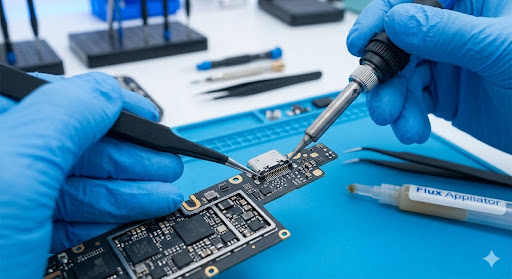
- Advanced Port Replacement (Soldering): If physical replacement is necessary, it often requires high-level micro-soldering. Our technicians precisely desolder the old port from the multi-layer logic board, clear the microscopic through-holes, and install a brand-new, high-quality component using lead-free, high-reliability solder and precision alignment jigs.
- Post-Repair Verification: We conduct testing across both power delivery (checking voltage and current draw) and data transfer capabilities to ensure 100% functionality.
Segment 2: Wireless Charging Coil Repair (Qi Standard)
Wireless charging offers unmatched convenience, eliminating cable clutter and physical port wear.
Understanding the Technology: Induction and the Qi Coil
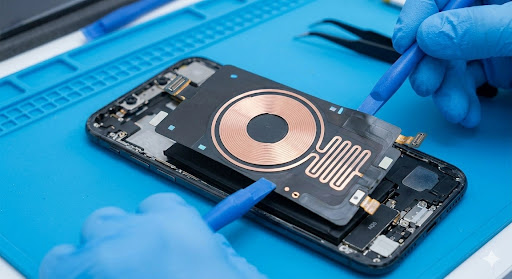
Wireless charging relies on inductive coupling. Inside the back of your phone, beneath the glass or plastic rear panel, lies a specialized component called the Wireless Charging Coil. This coil consists of fine-gauge, insulated copper wire tightly wound into a precise flat spiral.
When you place your phone on a Qi-certified charger (the universal standard technology), an alternating magnetic field is generated by the charger’s transmitter coil. When your phone’s receiver coil enters this field, a current is induced (created) within the wire spiral. This current is then regulated and directed to charge the battery. Modern coils also include advanced thermal sensors to monitor temperature during operation.
When is a Wireless Coil Repair or Replacement Necessary?
- No Wireless Charging Activity: The phone ignores the wireless pad entirely, suggesting a break in the coil’s windings or failure of the internal thermal circuitry.
- Excessive Heat: The phone gets dangerously hot when attempting to charge wirelessly, indicating damage to the coil insulation or faulty sensors.
- Physical Damage: Cracks to the phone’s rear glass can sometimes damage the delicate coil directly underneath.
Our Technical Approach: Safely Navigating the Assembly
Wireless coil replacement requires careful disassembly of the phone’s exterior:
- Accessing the Component: The coil is located directly beneath the phone’s back cover (often bonded glass). Our technicians must carefully apply heat and specialized tools to safely lift this panel without shattering it.
- Delicate Transfer: The coil is extremely thin and flexible. It must be carefully peeled from its adhesive bond with the phone’s chassis without tearing the fine copper wires. On some models, it is fused to other components (like NFC antennae), requiring expert separation.
- Precise Installation: The new, high-quality Qi coil must be aligned perfectly with the internal charging circuitry and the thermal pad.
- Verification: We test the wireless charging efficiency and closely monitor thermal performance.
Trust Phone Link Repair for Your Charging Needs
Whether you rely on a fast-charging USB-C cable or the convenience of a Qi pad, don’t let charging failures interrupt your connectivity. Contact Phone Link Repair today to schedule your diagnostic and repair service!
Other Services You Might Need
Charging port replacement
If your smartphone is no longer charging, if the connection is intermittent and requires “wiggling”…
View Details
Sim tray
At Phone Link Repair, we understand that a faulty or missing SIM tray can completely…
View Details